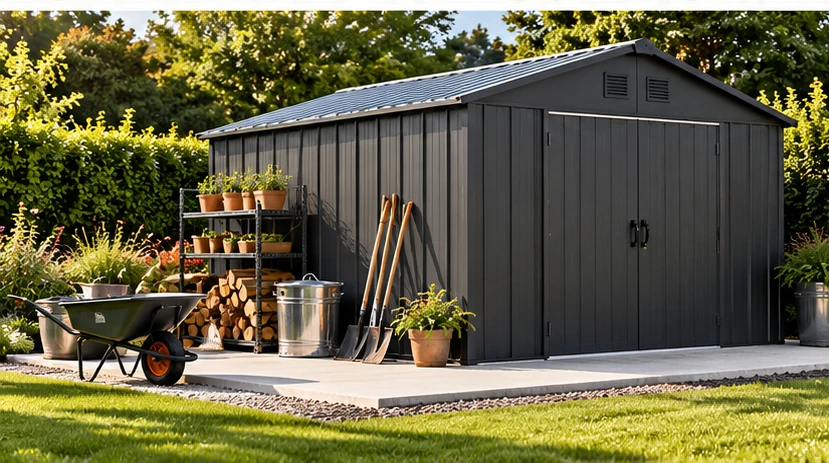
Illustrative editorial photography; not a photograph of any listed retailer product.
A decision guide to the tradeoffs that actually matter: maintenance, anchoring, customization, moisture and usable space. Check current product specifications, local building rules and real delivery costs before buying.
Wood: adaptable, but not maintenance-free
Wood wins when appearance, repairability and customization matter. You can often add shelves, change the finish, and alter nonstructural fittings more easily than with thin-panel alternatives. That makes wood attractive for potting spaces and workshops. The tradeoff is an ongoing need to manage water, paint or stain, insects and ground contact.
Ask what wood is used, how the floor is framed, whether it arrives treated or unfinished, and what ongoing finish schedule the seller recommends. A picturesque wood shed on a poorly drained base can become a recurring repair project. Good gutters, clearance and site planning matter as much as paint color.
Metal: practical, but look beyond the panels
Metal shed kits often appeal to buyers who want straightforward exterior storage without repainting wood. Some are lightweight and arrive in many pieces, so assembly time and safe handling matter. Thin metal doors and walls may not provide the same hanging capacity, dent resistance or insulation as heavy framed structures.
Look at the gauge or construction details rather than assuming all metal sheds are alike. Ventilation, condensation control, door track quality, tie-down requirements and corrosion exposure are important. Metal still needs a sound, level base, especially where wind may lift a light structure.
Resin: low-maintenance appeal with fit limitations
Resin and plastic-panel sheds are attractive for straightforward storage because many surfaces can be cleaned without painting. Some models include molded floors, skylights, vents or reinforcement points; others do not. UV exposure, heat, snow load and wall strength depend on the specific design, so use the seller's written specifications rather than blanket claims.
Look for usable internal dimensions, floor load limits and guidance on shelving. Not every wall accepts standard screw-mounted storage; some need approved accessory systems. Also check how replacement parts are obtained if a door or panel is damaged.
The honest decision rule
Choose wood when you value a traditional appearance and are willing to care for it. Choose metal when your priority is utilitarian storage and the model's structure and anchoring suit your conditions. Choose resin when ease of cleaning and a clean finished look matter, and the required dimensions are available.
The least expensive kit is not necessarily the least expensive finished shed. Compare a delivered, properly anchored structure with the necessary base, floor, ventilation and assembly labor. Once those extras are included, the ranking can change.
Next steps before you order
- Measure the yard, the object you need to store, and the route through the doorway.
- Compare complete specifications for at least two models—not just exterior style.
- Get the full delivered-and-installed cost, including any foundation and anchoring.
- Check your local building department and any HOA before making irreversible changes.
Ready to narrow the options?
Use the no-sign-up size finder, then compare sellers directly. No retailer is represented as a paid partner before approval.