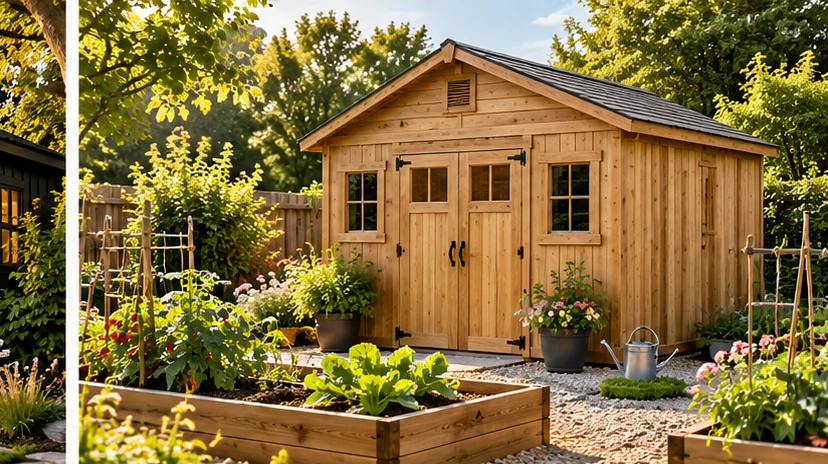
Illustrative editorial photography; not a photograph of any listed retailer product.
A practical shed sizing method that starts with what you own, door access and room to move, not just a nominal footprint. Check current product specifications, local building rules and real delivery costs before buying.
Start with your largest object, not the shed label
The right shed begins with a measuring tape and the one object that will be most difficult to move. For many households that is a lawn mower, a wheelbarrow, a bike with a wide handlebar, or the shelves you plan to install. Record the object's length, width and height. Then measure the route it will take through the doors. A wide building with a narrow doorway can still be the wrong building.
Next, lay the objects out on paper or the ground. Don't treat the floor as an uninterrupted rectangle. Doors swing, shelves project into the room, windows may prevent wall storage, and a mower needs a path to get in and out. The difference between fitting everything and actually enjoying the shed is usually a clear aisle.
Use square footage as a filter, not a promise
A nominal 6×8 shed covers 48 square feet; an 8×10 covers 80; a 10×12 covers 120; and a 12×16 covers 192. That arithmetic is helpful for shortlisting, but interior space can be smaller after walls, framing, cabinets and door clearance. Compare usable internal measurements when manufacturers provide them.
Some people choose a larger shed only because they haven't designed vertical storage. Wall hooks, hanging tool tracks and shelving can recover surprising space, but avoid hanging heavy objects on thin panels unless the manufacturer specifically allows it. Put weight closer to the floor and maintain access to the things you retrieve most often.
Plan for the way you use the space
A gardening shed primarily needs quick access to hand tools, potting supplies and awkward long handles. A bicycle shed needs generous door clearance and maneuvering room. A workshop needs a workbench, task lighting, safe electrical planning, dust management and enough room to move materials without hitting walls.
If you may buy a riding mower in two years, measure the future machine now rather than buying for today's push mower. If you plan to convert a storage shed into an occupied room, stop: insulation, utilities, ventilation, foundations and building approvals may be very different from those of a simple storage structure.
Check the site before you fall in love with a model
Measure your available yard area, noting trees, roots, downspouts, buried utilities and the route a delivery truck or installation crew would take. The roof overhang may extend beyond the nominal floor size. Local setbacks and easements can reduce the space where you are allowed to build, even when the structure itself seems small.
Before ordering, take one final pass through the specification sheet: assembled outside dimensions, interior dimensions, door opening width and height, floor inclusion, anchoring requirements and box or delivery dimensions. If any one of those is missing, ask the retailer.
Next steps before you order
- Measure the yard, the object you need to store, and the route through the doorway.
- Compare complete specifications for at least two models—not just exterior style.
- Get the full delivered-and-installed cost, including any foundation and anchoring.
- Check your local building department and any HOA before making irreversible changes.
Ready to narrow the options?
Use the no-sign-up size finder, then compare sellers directly. No retailer is represented as a paid partner before approval.