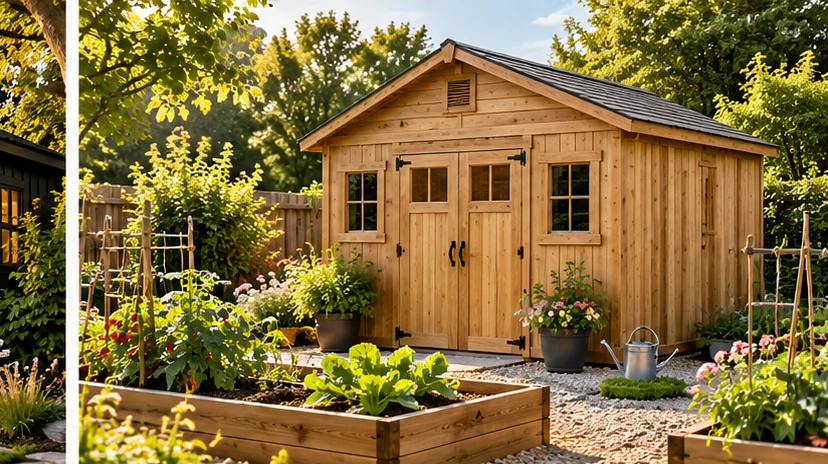
Illustrative editorial photography; not a photograph of any listed retailer product.
Compare 80 versus 120 square feet through layouts, storage capacity, access, cost planning and future use. Check current product specifications, local building rules and real delivery costs before buying.
The size difference is larger than it looks
An 8×10 footprint is 80 square feet. A 10×12 is 120 square feet, or 50% more nominal floor area. That extra room can be meaningful when you need an aisle between stored equipment and shelving, but a larger shed also requires more site space, a larger foundation and potentially a different local approval path.
Imagine tracing each size on the lawn with string. Then mark a line for a 30-inch circulation path and the width of your shelves. You may find the smaller unit is ample for seasonal boxes, while the larger feels dramatically less cramped when wheelbarrows, bicycles or a mower are involved.
Choose the smaller shed when access is simple
An 8×10 can work well for lawn equipment, bicycles and storage bins when the door placement supports the arrangement. It is often enough if you can place heavy tools on one side and shelves on the other without blocking access. For occasional-use items, wall storage may be a better use of money than paying for extra floor area.
But first verify door dimensions. If a mower must turn sharply just inside the entrance, an 8×10 may be frustrating even if the machine physically fits. Read product drawings and measure your gear at its widest point.
Choose 10×12 for mixed-use flexibility
A 10×12 is a stronger candidate when you want a defined work surface alongside storage. There may be room for shelves, a mower and a clearer path through the building. It also offers more flexibility for unexpected new equipment, though interior dimensions and roof shapes differ by manufacturer.
Do not interpret the larger footprint as automatic suitability for a home office, guest room or occupied workshop. Those projects can require different permitting, electrical, ventilation and structural choices from basic storage.
Compare complete installed cost
Instead of comparing only two shelf prices, ask the sellers to quote their kits with equivalent doors, floors, roof specifications and warranties. Separately price foundation preparation, anchoring, delivery, labor and any permits. A larger kit may trigger labor or site costs that are invisible in its online listing.
The best choice is the smallest size that handles your real storage layout and likely growth without turning every retrieval into an obstacle course.
Next steps before you order
- Measure the yard, the object you need to store, and the route through the doorway.
- Compare complete specifications for at least two models—not just exterior style.
- Get the full delivered-and-installed cost, including any foundation and anchoring.
- Check your local building department and any HOA before making irreversible changes.
Ready to narrow the options?
Use the no-sign-up size finder, then compare sellers directly. No retailer is represented as a paid partner before approval.